
On April 3, 2026, in Taunton, Somerset hosted Nottinghamshire, the defending county champions, for their season opener. Sent in to bat, they slumped to 20 for two under murky, cold skies. Batters wore cable-knit sweaters, and spectators wisely kept their winter coats on, many peering out from under hoods.
The imposing Notts fast bowler Dillon Pennington charged in toward Somerset’s James Rew. The pitch was lush, only slightly less green than the uncut strips beside it—closer to “Shrek’s forehead” than “Kermit’s belly” on cricket’s unofficial Pitch Greenness Scale. By August it would be pale, baked, and cracked—”Yoda’s shin.” For now, conditions heavily favored the fielding side. Rew tapped his bat and blinked at the bowler.
If you cupped your ear, you could almost hear the ghostly warnings of old pros on the chill breeze: “Never cover drive in April.” Those who relied on runs for their livelihood knew the shot wasn’t worth the risk, especially on treacherous springtime loam unhardened by the sun. In eras past, the cover drive was the flashy preserve of the gentleman player—a fine edge to slips or keeper wouldn’t cost them sleep or money. The professional knew better: put it away, lock it up. A cover drive before midsummer? Not worth it.
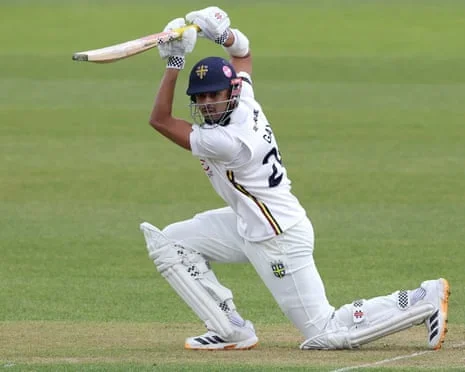
No one told Rew. Pennington sent down a full ball just outside off-stump, and in a split second Rew sprang to life. He pounced forward like a ruddy-cheeked D’Artagnan, thrusting his rapier to drive the ball along the ground to the boundary. He held the pose as the ball bisected the fielders, leaving no doubt as to the balance and poise displayed.
As Jon Hotten wrote, “The cover drive is not like other shots. It is dangerous and beautiful. It is decadent and depraved. It is the purest expression of mastery in batsmanship and it is a destroyer of innings, of matches, of careers. It is addictive, compulsive, indulgent. It makes crowds go ‘aaaahhh.’ It makes coaches slam their fists into dressing room walls.”
Consider lunchtime on day two of the first Ashes Test in Perth, in November. England were 59 for one with a second-innings lead of 99 when the curse of the cover drive struck. Ollie Pope and Harry Brook both fell caught driving outside off-stump to Scott Boland, then Joe Root was bowled attempting the same against Mitchell Starc. Root is a sumptuous cover driver but also a discerning one—you don’t accumulate nearly 14,000 Test runs by being reckless. His wicket was the gut punch. You expect such risks from others, but not from him. Seeing Root dismissed that way felt like witnessing the “sensible one” on a stag do dancing on the bar with his top off—and right after lunch.
England’s compulsion to play the cover drive ultimately cost them the Test in Perth and proved a decisive turning point in the series. Not that their batting coaches were left punching walls—Marcus Trescothick later admitted the shot remains both a blessing and a curse for modern batters.