

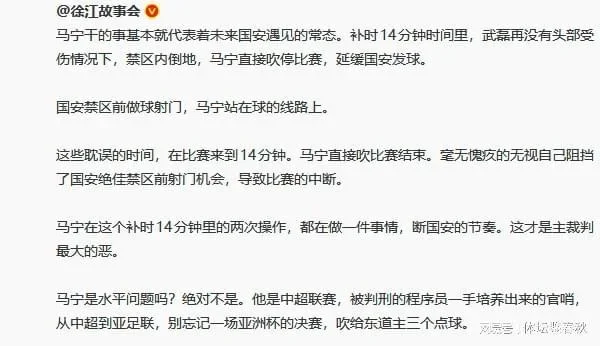
This season, Beijing Guoan’s league performance has been far from ideal, directly linked to a severe injury crisis and the team’s incomplete tactical integration. However, it must be acknowledged that repeated incorrect and missed calls by referees in several matches have directly cost Guoan points. Following Guoan’s match against Shanghai Port, a football media commentator remarked, “What Ma Ning did in that game basically represents what Guoan will face as the new normal.”
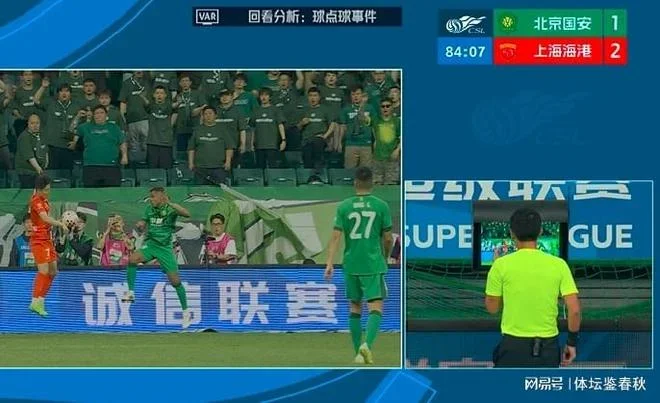
Objectively speaking, Ma Ning’s overall refereeing standards were not the main issue. What truly frustrated fans was the inconsistent application of VAR intervention. Similar actions by other teams often went unchecked by VAR, but when it came to Guoan, every potential goal seemed to warrant a review. Now, the biggest fear for Beijing fans isn’t the on-field referee, but whether the voice on the other end of the headset wants Guoan’s goals to stand.
Guoan’s continuous unfavorable treatment from officials has laid bare the logic of the Chinese Football Association (CFA). Perhaps no one would openly admit to targeting any team, but a seemingly casual remark can subtly direct referees on how to act. Everyone knows which teams to favor, which to avoid upsetting, and which teams can be subject to controversial calls without major consequences.
This isn’t a conspiracy theory; rather, the environment forces officials to choose the safest path. When a team is perceived by the CFA as being “less cooperative,” it’s easy to suffer from ambiguous decisions. It’s not a deliberate attack, but because no one wants to take the risk of shouldering responsibility for that team. After all, everyone’s livelihood depends on football. Over time, the club loses more than just points—it loses faith in the fairness of officiating.
Professional leagues are ruthless. Missing one point might just drop a team in the standings, but losing five points—especially if the team struggles all season—could lead to relegation. Right now, Guoan is paying the price for early-season chaos, injuries, and those inexplicable calls.
This also explains why more people are saying that Guoan cannot just rely on post-match appeals. Appeals are necessary, but if the club consistently hopes that “reviews will bring justice,” its mindset is too idealistic. Chinese football has never been just about the 90-minute match. Many clubs have long understood that communication with the CFA, maintaining various relationships, and maneuvering against other clubs are all part of the league.
One may dislike it, but it’s real. Guoan’s persistence over the years is commendable, but going head-on without strategy comes at a high cost, quickly reflected in the standings. So what should Guoan do? Should they simply compromise? Of course not. But relying solely on emotional outbursts is insufficient.
A more mature solution is to stick to principles while learning to survive more cleverly. Since Guoan’s management restructuring, the club has emphasized self-financing, making stable results more important than ever—rather than falling into the annual cycle of “we are being targeted.”
Thus, in upcoming matches, Guoan will likely continue to face calls similar to Ma Ning’s. This is the current reality of Chinese football. The club can be angry, can refuse to accept it, and can fight back, but if it fails to understand the CFA’s logic, it will keep falling into the same pit. In today’s Chinese Super League, a team’s true strength is not the only factor determining its results; off-field elements often play a larger role. If these issues are not clearly addressed, Guoan may lose far more than just those points this season.