

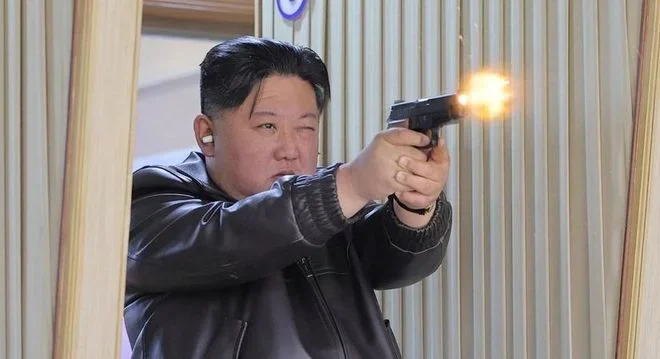
North Korea’s recent constitutional revision has sent shockwaves through the international community. The country has enshrined its nuclear rules into the highest law, drawing a clear red line that few would dare to cross. The consequences of crossing that line are chilling.
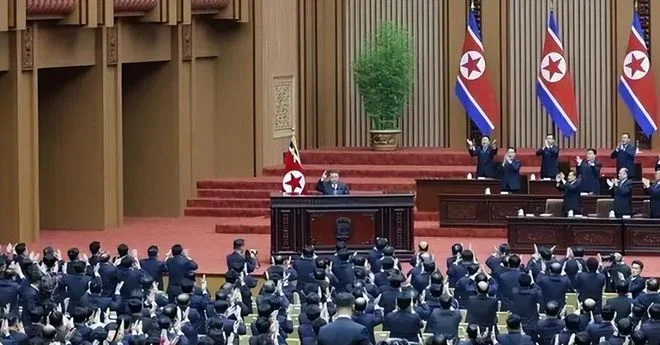
The amendment, dating back to March, introduced two hardline provisions. The first explicitly states that the chairman of the State Affairs Commission is the supreme leader of the nation. The second directly places the supreme leader in charge of nuclear weapons command, authorizing them to order a nuclear strike at any time.
While these two points might seem unremarkable on their own, when combined with the 2022 Nuclear Force Policy Act, the implications become stark. That act clearly states that if North Korea’s nuclear command and control system is attacked and paralyzed, all military units are authorized to launch a pre-programmed nuclear strike without waiting for orders from higher command.
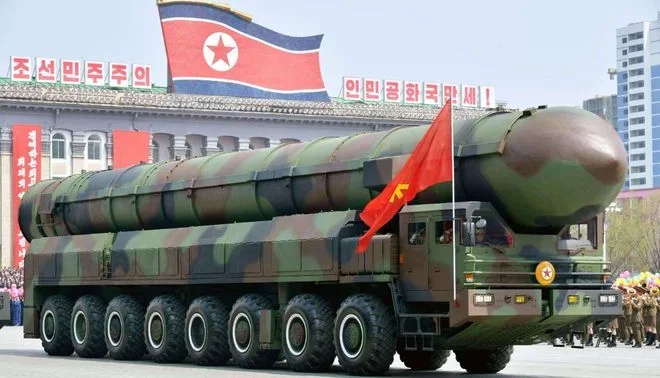
The 2022 law stipulated automatic retaliation when the command system is attacked. Now, the 2026 constitution enshrines the supreme leader’s command authority. South Korean media quickly interpreted the combination as North Korea installing an automatic trigger on its nuclear button.
In plain terms, if anyone attempts a “decapitation strike” on North Korea’s top leader—even if the first attack cripples the entire chain of command—the country’s nuclear missiles will still be launched according to pre-set plans, targeting whoever initiated the attack. This constitutional revision was announced publicly to the entire world, leaving no room for misinterpretation.
Why would North Korea take such an extreme stance, leaving itself no room to retreat? This is not a sudden act of madness. It was provoked by recent events. From late last year to early this year, Israel and the United States conducted several precision decapitation strikes on senior Iranian officials. In February, Iran’s Supreme Leader, Ali Khamenei, was assassinated by airstrike in his official residence in Tehran.
The assassination of a nation’s highest spiritual leader in his own home sent a shockwave through North Korea’s leadership, more impactful than any intelligence report. North Korea and Iran share a similar political structure with highly centralized power; the supreme leader is literally the brain and heart of the nation. The advantage is rapid decision-making and strong execution. The disadvantage is that if the brain is destroyed, the entire country can quickly descend into chaos.
North Korea is indeed more isolated than Iran, making it harder for the US and South Korea to penetrate and target its leaders. But isolation does not mean absolute safety. The US and South Korea possess F-22 and F-35 stealth fighters, drones, satellite reconnaissance, and electronic warfare capabilities. North Korea’s air defense system is not guaranteed to withstand multiple waves of saturation attacks.
If an enemy launches an airstrike directly at the supreme command post, no one can promise a 100% interception. North Korea’s logic is simple: since it cannot guarantee stopping the first blow, it must ensure that the one swinging that sword will also be destroyed. This is the essence of mutually assured destruction—tying the leader’s survival to the nuclear trigger. Dare to decapitate the leader, and you trigger your own countdown to annihilation. While extreme, the logic is sound.
After the Iran incident sounded the alarm, North Korea looked at its neighbors and grew even more uneasy. Since taking office, South Korean President Lee Jae-myung has talked about cooling tensions on the peninsula, but the military and right-wing factions in South Korea refuse to accept a nuclear-armed North and cling tightly to the US alliance.
In September last year, the US and South Korea conducted the “Hammer” joint military exercise, which North Korea immediately denounced as a rehearsal for a nuclear strike against it. Japan quietly revised its National Security Strategy, giving its Self-Defense Forces the power to launch preemptive strikes and purchasing a large number of Tomahawk cruise missiles from the US, which have a range covering all of North Korea and are difficult to defend against at low altitude.
South Korea and Japan are firmly aligned with the US. The trilateral military exercises have become frequent. After the “Hammer” exercise ended, the three nations conducted the “Freedom Blade” exercise in the open sea southeast of Jeju Island. They claimed it was defensive, but bringing aircraft carriers, stealth fighters, and Aegis destroyers makes it hard to believe it’s purely defensive.
North Korea is now surrounded by this situation: constant military exercises, ever-advanced equipment, and mounting pressure right at its doorstep. The decision to write this iron law into the constitution is essentially a self-defense mechanism forged under long-term pressure, not an irrational outburst.
Of course, tough words alone are not enough. North Korea’s capability backs up its claims. According to South Korean assessments in early 2026, North Korea already possesses approximately 40 nuclear warheads. Its intercontinental ballistic missiles, such as the Hwasong-15 and Hwasong-17, have a range that can reach the entire US mainland.
The US Department of Defense’s own internal assessments acknowledge that North Korea currently has fewer than 10 ICBMs capable of hitting the US, but that number could rise to 50 by 2035. More crucially, North Korea’s nuclear deterrent has evolved from a single-track system to a dual land-sea layout.
In 2024, North Korea launched its first nuclear-powered tactical submarine, the “Kim Kun Ok Hero.” In 2025, it unveiled a new submarine capable of carrying a large number of long-range missiles. Many speculate that the technology for these submarines likely came from Russia, especially after the two countries signed a mutual defense treaty, bringing their military cooperation very close.
Russia may have provided not only submarine technology but also assistance with launch vehicles and satellite navigation. The implication is clear: even if the US and South Korea destroy all of North Korea’s land-based missile sites, as long as one nuclear submarine lurks deep in the ocean, it can deliver nuclear warheads to the enemy’s doorstep. This second-strike capability is the true anchor of North Korea’s nuclear deterrent. With this, the iron rule written into the constitution is no longer an empty slogan but a concrete life insurance policy.
It is a grim reality. North Korea has a population of just 20 to 30 million people, its economy has been blockaded for decades, and its conventional military forces are no match for the world’s most powerful military alliance of the US, Japan, and South Korea. Against such odds, the country has been cornered into this desperate choice.
North Korea has called its own bluff, laying its bottom line on the table with no way back. It is a tragic act of self-preservation—the last shred of dignity for a small nation pushed to the edge.
Source: Global Times – North Korea’s constitutional amendment stipulates nuclear retaliation; nuclear weapons will be automatically used if the supreme leader is assassinated.
